grayestofghosts: a sketch of a man reading a paper (reading)
 Note: this is partially from a Tumblr post yesterday that I’ve since added to.

I am becoming increasingly frustrated with how, when I go to the library, the fiction seems to be divided up into “girl books” and “boy books”, and I don’t think it’s that this is at all new but that there are  many more “girl books” now released that it’s become more noticeable. The “boy books” are written by men with practiced blindness do not acknowledge gender as a factor in them at all as gender is dictated by society as Not The Purview of Men And They Are Therefore Exempt From Any Understanding Lest Anyone Think Them Kinda Faggy, and the “girl books” are entirely about how women are treated badly in Society Because They Are Women And Not Men, And This Is The Only Gender Conflict That Matters. I have read much of both types of books — because they’re like 95% of all books — and find neither relatable at all. I am sick of both of them and they seem to take up the entirety of the bookstore and once I understood this it’s nearly destroyed my love of reading. Every single book I pick up is about a totally alien planet inhabited by complete strangers who find my very existence offensive to their sense of reality. And this is my real life, too, and it’s why I still try to write despite the fact that I struggle to read so much.

And I can’t say it’s because I only desire to read books about myself and people exactly like me, because, again, nearly all I’ve read has been either girl or boy books. A decent amount of my reading list has been romance novels because it’s one of the only genres out there where men can have genders and this can be good, which is one of my major complaints of “girl books” otherwise — and it’s bizarre that romance novels are constantly belittled and segregated into “wish fulfillment” whereas the woman-solidarity endemic to “darker” stories is equally as fantastical as men with genders existing and that possibly being good. 

And you’d think that with so many queer books coming out now I’d be more engaged but I’m not, because so often it’s used as an excuse to further segregate boyness and girlness in books rather than cross any barriers. And I do feel like there are huge issues with a lot of the transmasculine books that have been published, but mostly in that they’re entirely presented in a way that’s palatable to the public, and it’s maybe not a them problem but a me problem in how it’s even more painful to read a book that’s supposed to be ‘like me’ only to realize it’s not ‘like me’ at all and it’s merely ‘about me’ except it’s not accurate to me, specifically, at all. 

I continue to write but unfortunately so much of what I read has gone into classics and that makes me feel unable to engage at all with traditional publishing and the industry. I’d like to read other things but somehow it’s easier to read things that you know are steeped in metaphor you can reinterpret rather than… girl books and boy books. 
grayestofghosts: a sketch of a man reading a paper (Default)
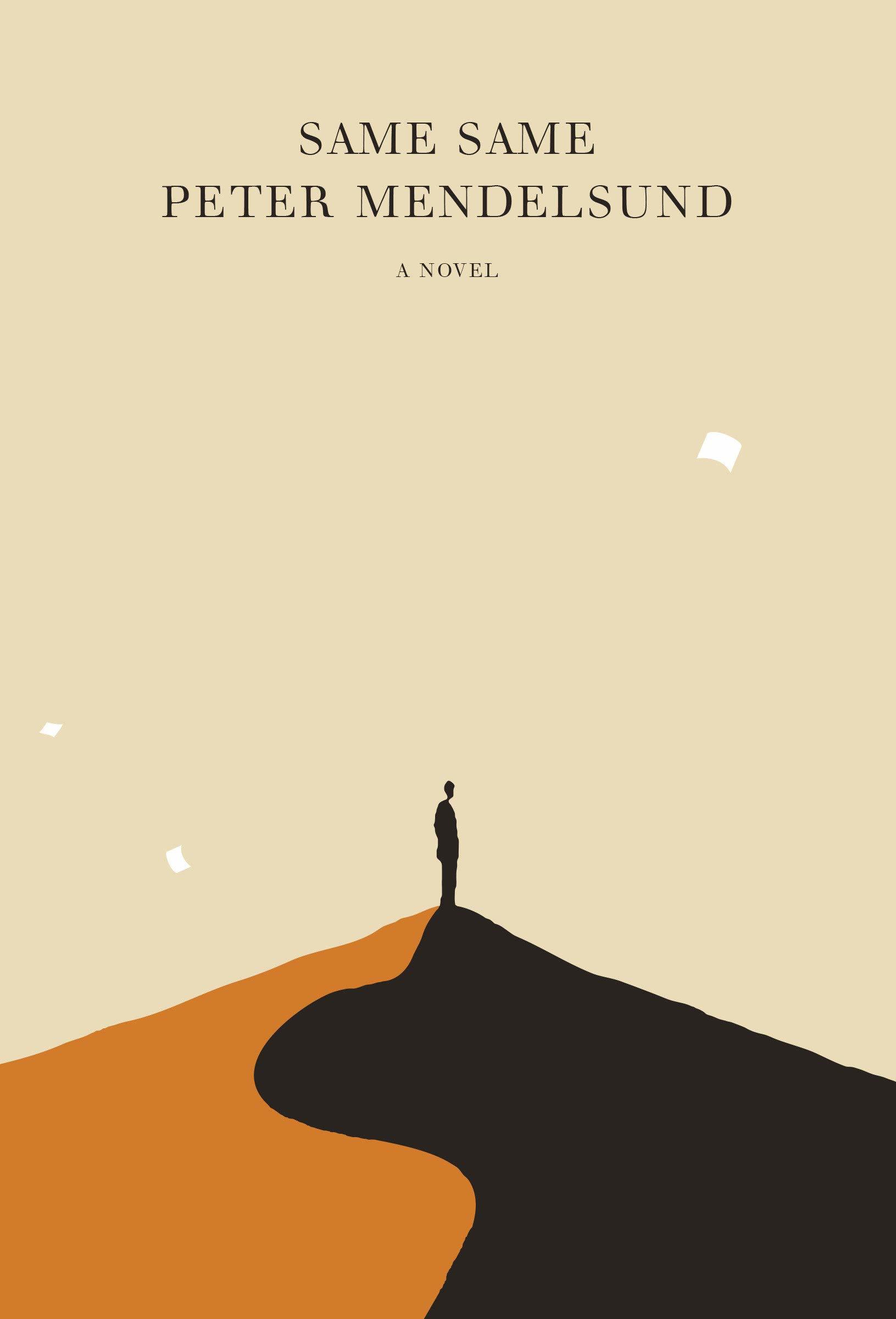
Cover of Same Same by Peter MendelsundI just finished the book Same Same by Peter Mendelsund and I am not sure if I enjoyed it. I bought it because the cover caught my eye and the blurb sounded intriguing:

In the shifting sands of the desert, near an unnamed metropolis, there is an institute where various fellows come to undertake projects of great significance. But when our sort-of hero, Percy Frobisher, arrives, surrounded by the simulated environment of the glass-enclosed dome of the Institute, his mind goes completely blank. When he spills something on his uniform—a major faux pas—he learns about a mysterious shop where you can take something, utter the command “same same,” and receive a replica even better than the original. Imagining a world in which simulacra have as much value as the real—so much so that any distinction between the two vanishes, and even language seeks to reproduce meaning through ever more degraded copies of itself—Peter Mendelsund has crafted a deeply unsettling novel about what it means to exist and to create . . . and a future that may not be far off.
 
So from the blurb it sounds like a magical realism novel about the insufferable world of the people who do TED talks, cool. It’s a thick tome, 483 pages long, and I picked it up because it looked like one of those literary-like books where there would be a lot of words but not much action and because I had been going through a lot of shit in my life (and let’s be real, when am I never going through a lot of shit in my life), I thought it would be a bit of a breather. I guess it delivered, because that’s mostly what it was, but I really wish it was, well, better? Maybe more character focused, having a bit more candy flavor than pure textual flourish to keep me interested because I don’t think I was that invested until I got to maybe the final quarter of the book.

However I find that this book has a major problem. This problem is not anywhere within the covers of the book itself; rather the problem is that this book was shelved in science fiction and fantasy in every bookstore I’ve seen it, and it’s not a science fiction or fantasy book.

Spoilers Below )
grayestofghosts: a sketch of a man reading a paper (Default)
I wrote these thoughts down about a month ago and am only now getting to posting them. I am current with the books of A Song of Ice and Fire, though that's not saying much considering the release schedule. I have no interest in watching the TV series after the first couple episodes, and I've heard that a lot of people have a hard time watching it because it’s too dark and depressing.

ASoIaF is the example critics usually give for the genre of “grimdark”, a genre whose definition is pretty loose, but is generally characterized by its relentless pessimism, or what some consider to be “realism”. Liz Bourke gives a compelling definition for grimdark in her review of The Dark Defiles by Richard Morgan: “"Grimdark" is a shorthand in modern fantasy literature for a subgenre that values its gritty realism, and that attempts to overturn long-established heroic tropes. […] for me its defining characteristic lies in a retreat into the valorisation of darkness for darkness's sake, into a kind of nihilism that portrays right action—in terms of personal morality - as either impossible or futile.”  She goes on to elaborate, “I think it's a nihilism that many people find comforting: if everything is terrible and no moral decision can either be meaningful or have any lasting effect, then it rather absolves one from trying to make things better, doesn't it?” Further criticism of the genre points to its use of brutality of marginalized people as “realistic” backdrop as exploitative and catering to the fantasies of the (typically white, young, male, heterosexual, cisgender) audience is pretty damning. Because of this, genres to counter the popularity of grimdark have taken on a tone of moral crusade. First was the concept of noblebright, the exact opposite, where good can absolutely triumph over evil, and then hopepunk, which asserts that good isn't a destination but that rightness is an action that should be aspired to. Bloggers who write at length about these two genres argue that they have enough “darkness” in their lives that they don't want to see the descent in depravity that they've seen in real life reflected in their fiction, as well.

I'm going to be honest. I don't really like any of these genres. I don't like the broad pro- or anti-morality stance of either of them. And I have a probably controversial opinion:

Grimdark is not cynical enough. )

Profile

grayestofghosts: a sketch of a man reading a paper (Default)
Louis Chanina

December 2025

S M T W T F S
 123456
7 8910111213
14151617181920
212223 24252627
2829 3031   

Syndicate

RSS Atom

Most Popular Tags

Style Credit

Expand Cut Tags

No cut tags
Page generated Jan. 6th, 2026 02:55 am
Powered by Dreamwidth Studios