grayestofghosts: a sketch of a man reading a paper (Default)
I was thinking about the web art/photography phenomenon of 'liminal pools', and was watching a video by youtuber Nightshade most particularly about Jared Pike's art. The video itself is interesting and I also read I think on a reddit post about how people who tend to enjoy or desire solitude find these images calming while people who need people more find them distressing (I love looking at them, and my boyfriend was immediately put off by them).

But I think something that's missing from the overanalysis of Nightshade and a lot of analyses of liminal pools in general is that until very, very recently, you could not bring your phone (or any electronics) to the pool, which I think for at least a certain set of people brings a feeling of nostalgia and calm of not being connected. In the liminal pools, the vibe it brings you is that you are safe from emails, essentially, ironically, considering people are generally viewing these images on a device that receives constant internet communication. While Jared Pike does sell prints of his work, I have a feeling that just sticking it on a wall would not be the same.
grayestofghosts: (percy)
Watching Twitter go down the tubes is making me sad. Like the discourse of the people I'm adjacent to just keeps getting worse and worse and more and more frequent, it feels like and it's very unenjoyable to look at... but at the same time it's still the best source for artists I like because the artists haven't made the leap to another platform, it seems like.

I think the smart and sane thing to do is to try to set up an RSS feed for the artists accounts I like, but that's been mixed success, and nitter.net seems to be spotty right now as twitter falls apart. I am hoping eventually these artists make the leap to bluesky (or otherwise? I know bluesky is similar and has policies that allow NSFW, though it is very, very much so not a mature platform yet) or do... something. I just want other options and twitter just continues to deteriorate.

I'm very tired.
grayestofghosts: (percy)
A very interesting episode of the podcast Hooked On Pop came out last week called Invasion of the Vibesnatchers which seemed particularly relevant to my piece on AI art generators as potential IP laundering machines. It's a very, very interesting comparison on how two similar phenomena are being dealt with in two different mediums and how, with both of them, the artists seems to lose.

Most people are not familiar with how music credits and pay works. Various methods of what might be called 'collageing' have been used in popular recorded music since forever -- from literal clips being 'sampled' and used in a new way in a new song, or melodies repeated and reinterpreted and on and on. Also, in the United States, there's a very defined structure of who owns music, and therefore who gets money every time a song is played, so when pieces of a song are used in another song who gets a cut and how is very predetermined. Because of this structure of the business, nobody wants to step on anyone else's toes too badly, so often credit will be pre-emptively awarded before there's any kind of conflict leading to lawsuit if a company thinks there might be an issue. All of this is happening under the listener's nose unless they really look for these credits. Actual disputes like over Robin Thicke's "Blurred Lines" are not common and when they do happen they're usually settled pretty quickly.

Now, an "interpolation" isn't as straightforward a copy as a sampled clip or a repeated line of melody. The example analyzed at the beginning of the podcast showed that no individual piece of the song could be considered really copied directly from the old song being credited, but given that it has a a similar instrumentation, similar structure, etc and certain parts that are relatively unique, like a repetitive whistled melody, the old song is given credit, and with that credit the owners of the credited song get some small cut of the profit of the crediting song.

Later in the episode the host reveals that interpolation credits in popular music have increased from about 10% per year before 2017 to about 20% per year afterward, and the major reason cited why is that, well, the record companies that own songs are encouraging it. There's a definite profit motive here -- when someone uses a song they already own to make something new, they will get a cut of the profit from that song, and the more vague the definition of "use" becomes, the more credits they can have, and therefore the more money they will make without having to even acquire more songs.

Now, I can make an argument against this practice due to the "modern media companies encourage homogeneous sludge" argument, but the more important note is how different the music industry is treating music credits versus how visual art credits simply do not work and allow for AI art to sneak in. If you made an AI music generator instead, made it scan top 40 hits back decades for its learning set, and then started posting the music as your own creation or as a way to get "free music", the RIAA would have your ass on a platter in less than a week.

And I am not saying this because the RIAA is 'good' -- it's not like the record companies, once they get that interpolation credit, are actually distributing that cut of profit fairly. But it's so demonstrative of how, when it comes to who makes money on art, it's entirely down to might makes right, and the only reason AI art is allowed to exist as "free art generation" is because it is taking exploiting artists who have no legal or financial power to stop them.

grayestofghosts: (percy)
I keep reading doomsday declarations about what AI art will do to actual artists and their possibility of getting paid and at this point I’m convinced that everyone writing about this is missing the point. Artists have not been paid what they’re worth for a long time, either by exploitation or outright theft of their work. The homogenized, regurgitated slopification of art — no, I’m sorry, content — has been going on forever in the form of Save The Cat making all Hollywood movies the same, the MCU taking over cinema, the Penguin Random House/Simon and Schuster merger (including a hearing where they admitted they have no idea how books get popular), the insane scheduling requirements on Instagram to get any attention whatsoever, “crunch time” ruining game creators lives, all the way down to T-shirt bots trawling Twitter. If you read Little Women, Jo gets paid about the same amount in dollars for her short story during the Civil freaking War as a writer today would get upon winning a similar contest. I’m not saying it can’t get worse, but the idea that AI will change the fact that companies and unscrupulous individuals will do anything to avoid paying artists for their work, up to and including outright theft, by convincing them and everyone else that all “art” is essentially interchangeable, is nothing new, to the point that I wonder where the fuck anyone making these statements about AI art has been for the last ten years at least.
 
Art or “Art” is not the point here. The term "AI art generators" obfuscates what these programs are actually doing, and that's laundering intellectual property.
 
For AI to do anything it needs to be trained on a large data set. So, for an AI to make “art”, it needs to be trained with a large data set of “art”, which through “learning” it can then remix trends into the images it spits out. So, the biggest, most obvious question, then, is where is this “art” it is being trained on coming from? By the image sets DALL-E generates online, it's very obvious that the art it has used in its sample is not free, based on the fact that what it is best at creating is obviously someone else's intellectual property. It can generate very reliably images including "Pikachu" or "in the style of Frank Miller", meaning that the program must have analyzed tons of images of Pikachu and by Frank Miller, and not one article I've seen talking about art generators actually notes that to use these images, the user would have to actually pay whoever owned these images and properties to use them commercially, even if the final piece being used was generated by one of these AI programs.
 
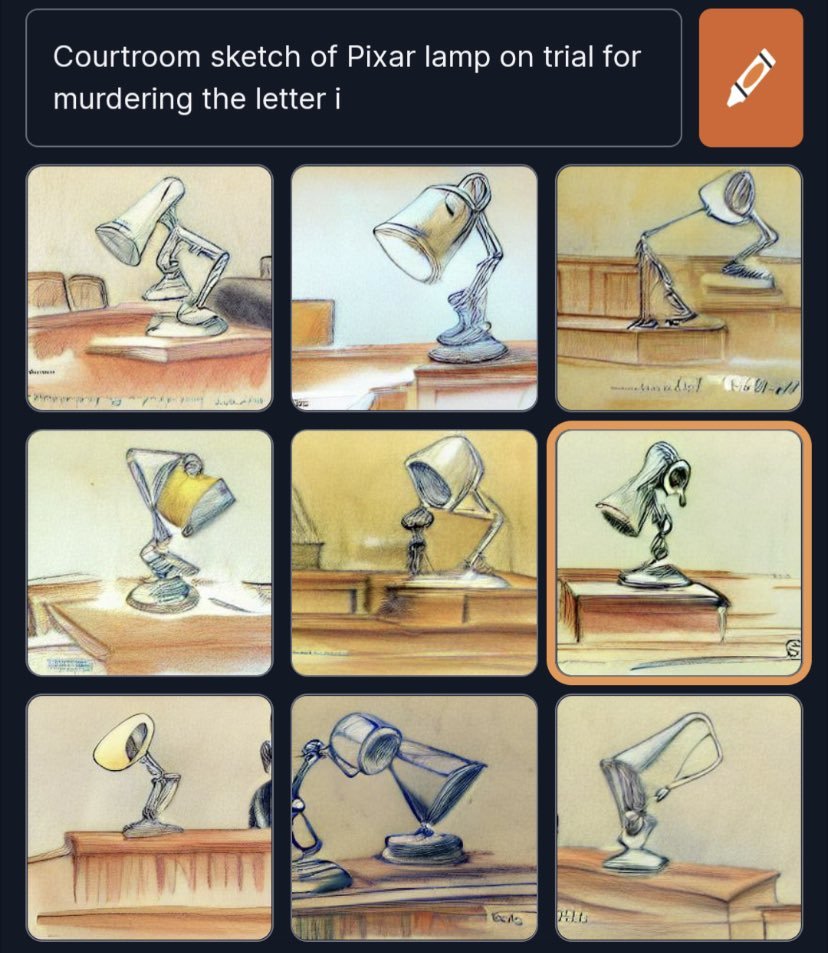
DALL-E is able to exist and pull from these images probably because it's assuming that the use of copyrighted images and properties would be protected under fair use, with the argument that it's not for commercial use and the demonstration with these commercial properties is a part of the educational or scientific value of the generated pieces. However, I could imagine a large company like Disney deciding that it did not like users creating images of Mickey Mouse at strip clubs and send a cease and desist request that all Disney properties be taken out of the learning set, which would leave users suddenly unable to make images of Darth Vader making the first pitch in Dodger Stadium or courtroom sketches of Sora being tried for manslaughter.
 
But Disney is Disney. What about everyone else? I am not a lawyer, but I think this gets both easier and harder. As long as we're discussing fair use of images, Mickey Mouse at a strip club could be argued to be a parody or criticism somehow, while, say, if a drawing I made of a flower I found in my backyard was added to the data set, it would be really hard to argue anything made with it would be parody or criticism of the original work because I'm a nobody. There would be nothing specific in that image to parody or criticize because I am not known enough to parody or criticize. The use of my artwork in the dataset would strictly be used in a straightforward, instrumental fashion, and there would be no reason for them to not use any other picture of a flower. An AI using my random artistic renderings would very likely be a violation of fair use, but because of the way AI generate their images, it may be very hard to prove that my image was used unless the AI hiccupped and left my watermark in the generated image -- thus the intellectual property laundering potential of these programs.
 
The legal issues in using an AI art generator to make commercial art would have to be argued in court. Is an image created by an AI art generator transformative or derivative? This would likely have to be argued on a case by case basis. The real meat here would be, would the individual responsible for compiling the data set for the AI also be responsible for getting permissions from artists when their art is added to the generator, because the art generated may not be sufficiently transformative? Must Disney allow Mickey Mouse to be used in the generator because of the likelihood of the generated work being parody, or can it disallow Mickey's addition to these data sets outright? What are the implications of this for other artists? Etc.
 
Honestly I think the misunderstanding of the actual problems with these AI art generators is not because people don't understand how AI works (even though they don't), but because they don't understand how copyright and intellectual property work. While the DMCA has changed this slightly, it's still very rare for randos on the internet to get smacked for misusing or stealing art they find online while the legal system has been coping with integrating new technology doing copyright infringement since copyright has existed. The people freaking out definitely seem like they have never had to deal with purchasing a stock image or getting permission for music sampling.
 
The idea that there's no humans involved with creating AI art beyond the user typing input is just demonstrably false. If I type in Frank Miller into a generator and it creates something Frank Miller-esque, then Frank Miller was involved with the creation of it. If these generators have not already paid the artists for the data they've trained their AI on, then it's extremely likely we have another Napster on our hands. I don't think comparing AI generated art to music streaming is actually a bad comparison -- it could be very bad for artists in the end, but in a totally different way than the initial doomsayers claimed. It's easy to imagine people who were already stealing art putting the art through an AI to tweak it to make it more difficult for artists to find and send them a DMCA takedown. It's easy to imagine AI generated art replacing stock images in many cases, and the artists that produce stock getting a smaller and smaller cut because, while their images are being used, they're only being used "in part" so the companies facilitating this decide they deserve less money for it. I can even imagine a far future where the final product of art is so untouched by human hands because all human-made art goes into the art-slush and what is wanted by the consumer is pulled out as needed, but the original human-made art was still necessary. It's hard for me to imagine AI generated art replacing huge swaths of the art market with "free" art where it wasn't before, because the US government has prevented that from happening repeatedly -- from photocopiers, to VCRs, to Napster, ad nauseum. The toes being stepped on by these generators are too big to ignore.
grayestofghosts: a shiba inu in a blanket (shibe)
In the meantime I've been thinking about having more serious posts on here but in the meanwhile I'm having serious early 2000s internet nostalgia, thinking about the geocities and pixel art I made in elementary school. Some things have definitely improved while I do think the way most social media is, putting lots of people in a small pit to fight it out and intentionally making them see content that makes them angry for "clicks" has... well, made the world worse.

Back in the days of neopets I had a geocities website with a seafoam green background and a page counter where I posted my pixel dolls. I was very fond of certain artists, and one of them at least, KawaiiHannah is incredibly still around though she seems to do traditional art mostly now though her pixel art is still online.

I was thinking about how I probably would not have the patience to do pixel art now. I mean, I have a lot of tedious hobbies and interests, sure, but I guess the reward for it would not be as much now. There was a lot of community around this stuff and now I have no idea what I would do, it just seems like shouting into the void. I mean there's doing art for art's sake, I know that and do that, but like, when I do that I use physical media, because having something that's not just computer data is... well, it's something, at least.

I was looking at carrd as an alternative to the old-style static sites and I have a resounding maybe. There's also neocities, but again I do not know how much I remember of HTML and CSS and if I have the patience or energy to make a new site from scratch right now. There's also, you know... what I'd put on it. I don't even know. It's hard enough to maintain a blog, because I think I should have something important to say to post. A static website? That's even moreso!

It's really hard to be the change one wants to be, especially when there's no one else around. I really should use this site more. Bleh.

Profile

grayestofghosts: a sketch of a man reading a paper (Default)
Louis Chanina

December 2025

S M T W T F S
 123456
7 8910111213
14151617181920
212223 24252627
2829 3031   

Syndicate

RSS Atom

Most Popular Tags

Style Credit

Expand Cut Tags

No cut tags
Page generated Jan. 4th, 2026 05:34 pm
Powered by Dreamwidth Studios